How do sustanable packaging options like BioBottles drive your supplement brands sales?
Your supplement bottle says "pure." It says "clean." It says "nothing artificial, nothing your body doesn't need." Then it sits in a warehouse at 90 degrees, rides a truck across three time zones, and lives on a shelf under fluorescent light for eighteen months.
The pill inside was engineered to a spec. The bottle around it was chosen because it was cheap.
That gap is the entire story of why conventional plastic keeps winning quarterly and losing the decade. And it is why the brands paying attention are already moving.
Why cheap plastic is only cheap on paper

Conventional resin is cheap because its real costs land on someone else, later. The contamination liability, the retailer sustainability scorecard penalty, the regulatory exposure as markets tighten, none of that shows up on the resin invoice. The commodity supplier pockets the margin today. Your brand inherits the bill.
Only about 9% of plastic ever made has been recycled (OECD Global Plastics Outlook). Roughly 50% is landfilled, 19% is incinerated, and 22% is mismanaged into the environment. Read that first number again. Nine percent. Everything in the other 91% is a candidate to break into persistent fragments that never leave.
That is not an abstract problem for a supplement brand. Marfella et al. (2024, New England Journal of Medicine) found patients with microplastics detected in arterial plaque had a 4.5x higher risk of heart attack, stroke, or death over 34 months. Your customer bought your product because they care about what enters their body. They are exactly the person reading that headline.
The customers you want already care, and they pay
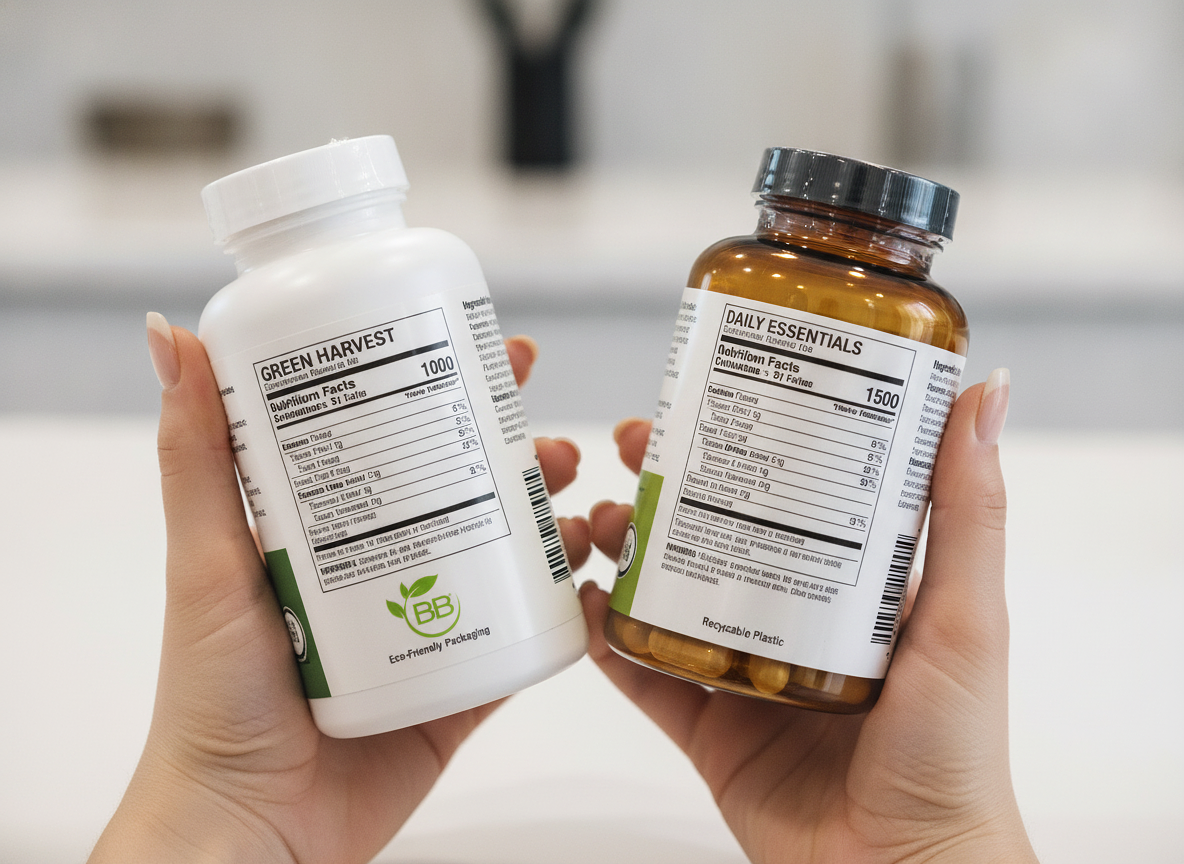
Here is the counterintuitive part sourcing managers keep getting told is impossible. Sustainability does not cost you sales. It drives them.
NielsenIQ, tracking actual purchase data across five years, found products marketed with verified sustainability claims grew 2.7x faster than their conventional equivalents. Not survey intentions. Register scans. And those same SKUs command a measurable price premium at the same time.
"The brand that switched captured the margin AND the volume. The holdout brand handed both to a competitor."
That is the acquisition half. Now the loyalty half, which is where supplements actually live.
Supplements are a subscription category. Reorder rate is the whole business. A customer who feels a values-match with your brand does not comparison-shop every 30 days, and packaging is one of the few signals they physically hold. A bottle that visibly backs the "clean" promise reinforces the reason they subscribed. A bottle that quietly contradicts it gives a churning customer one more reason to leave.
You are probably thinking customers will not notice the bottle. They noticed the label enough to buy. The bottle is the label's biggest lie or its best proof, and they are holding it twice a day.
Where BioBottles® and BioCaps® come in

So here is the packaging that closes the gap. BioBottles® are HDPE and PP supplement bottles built with PlasticIQ® technology, a BioPolymer Catalyst blended in at roughly 1%. Green Frog Packaging also offers BioCaps®, closures built with the same PlasticIQ® technology so that the entire package, bottle and cap, carries the same microplastic-free standard. Under normal use, BioBottles® and BioCaps® perform and recycle exactly like the packaging you ship today. The difference shows up only if a unit escapes containment: instead of fragmenting into persistent microplastics and stopping there, the material oxidizes in a controlled way until the chains break down small enough for microorganisms to actually digest it.
That full sequence is verified under ASTM D6954, a three-stage test protocol that checks the material oxidizes, then that microbes genuinely consume it, then that no harmful residue is left behind. BioBottles® meet ASTM D6954 standards for degradation and are also FDA food-contact compliant and recyclable through standard HDPE and PP streams where programs exist. Local programs may vary.
The claim your customer needs is short: No microplastics. Please recycle.
Compare that to the alternatives everyone name-drops. Plant-based bioplastics like PLA or PHA usually need industrial facilities most consumers cannot reach, and they can foul your existing recycling stream. Fiber and paper bottles struggle with the moisture and barrier demands of hygroscopic supplements. Both ask you to rebuild your line. BioBottles® and BioCaps® drop into the process you already run.
Why microplastic-free is the direction, not the trend
Microplastics do not just sit there. When plastics photodegrade in sunlight they emit methane and ethylene (Royer et al., PLoS ONE 2018). A 2026 Nature Climate Change study from Fudan and Duke found microplastics darkening the ocean surface trap enough extra solar heat to contribute roughly 16% as much warming as soot in affected regions. Researchers have compared the effect to running about 200 coal-fired power plants.
Regulators in many markets are already restricting fragment-shedding materials in consumer applications. Inventory built on conventional plastic today is inventory that gets harder to place tomorrow.
Back to that warehouse. Same heat, same trucks, same eighteen months on the shelf. The pill was engineered to a spec. Now the bottle and cap can be too, and your customer gets to hold the proof.